


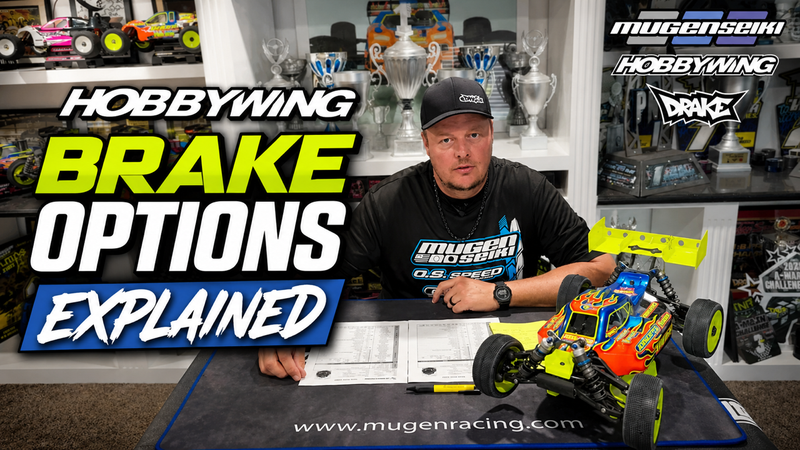
Photo: The Drake Racing (source)
Hobbywing brake settings are one of those menus many drivers leave on the factory configuration, simply because they are not sure what each line actually changes. Adam Drake has just released a tutorial video that goes through the five braking parameters offered by Hobbywing speed controls and their concrete influence on how the car behaves.
The five brake settings on a Hobbywing speed control
Drag Brake: this is the brake applied automatically as soon as the trigger returns to neutral, expressed as a percentage. It reproduces the effect of engine braking and is mainly used to settle the car on corner entry without touching the brake.
Brake Rate: this parameter controls how quickly braking builds up as you pull the trigger. A high value gives an immediate, sharp response; a low value makes the action far more progressive under your finger.
Brake Frequency: this is the frequency of the signal sent to the motor while braking. It changes the feel at the trigger and the way the tyres work: a low frequency generally gives a more aggressive brake, a higher frequency a smoother, more linear one.
Max Brake Force: this is the maximum braking power available at full trigger. Lowering this value limits wheel lock-up on low-grip surfaces; raising it shortens braking distances when the track has grip.
Brake Curvature: this last setting defines the shape of the curve between the start of braking and maximum power. You can therefore obtain a linear response, or on the contrary a gentle first part of the travel followed by a rapid build-up.
Where to start with brake tuning
In practice, these five parameters interact with each other, so it is best to change only one at a time and run a few laps before judging. Drag brake is often the first lever to explore, because it shapes corner entry across almost the whole lap. Then come maximum force and curvature, which let you match the bite of the brake to the grip level of the day.
A key subject in 1/8 off-road
On large off-road tracks, where braking zones follow long straights and jumps, braking quality matters as much as available power. A car that locks its wheels at corner entry loses stability on landing and makes its tyres suffer needlessly. Adam Drake’s explanations offer a simple method to take back control of settings that are too often neglected.
🔗 See the product page at The Drake Racing →Read also

Adam Drake, a huge quadruple podium at JBRL Round 5 in Palm Desert

Frankie Contreras Jr. joins The Drake Racing in 1/8 nitro buggy
![Adam Drake explains when to replace your RC buggy’s driveline parts [VIDEO]](https://rc-news.fr/wp-content/uploads/2026/09/1_FQo5ieP.max-850x450-1-640x400.webp)