


Pitboard RC: Tony Masclet (Tony RC) launches the app that keeps clubs alive on its own
On his YouTube channel Tony RC, you mostly see race debriefs, tests of cheap gear and quite a bit of vintage. Tony Masclet has been filming the life of his club, RC Park, for several years now. A GP in Nantes with a great TT 1/10 field, a round of the French buggy championship in Desvres, a €170 Hobbytech XMID that he ends up bringing home in 2nd place out of 33 in the final. A whole weekend spent in Göttingen for the Euro Masters, surrounded by old Kyosho and Associated cars. The FFVRC even entrusted him with a 1/10 buggy tire test as part of a call for tenders. In short, a guy who really races, not just a presenter.
And this month, a change of hat. President of RC Park for several seasons, he’s releasing his own tool: Pitboard RC. And he’s offering it to any club that wants to use it.

The problem, plain and simple
Nothing very original at first. It’s the problem of every club committee: once the weekend race is over, hardly anyone comes back to run during the week. No stakes, no up-to-date standings, no reason to. Tony Masclet says it himself on the presentation page: between sessions, RC Park would go flat.
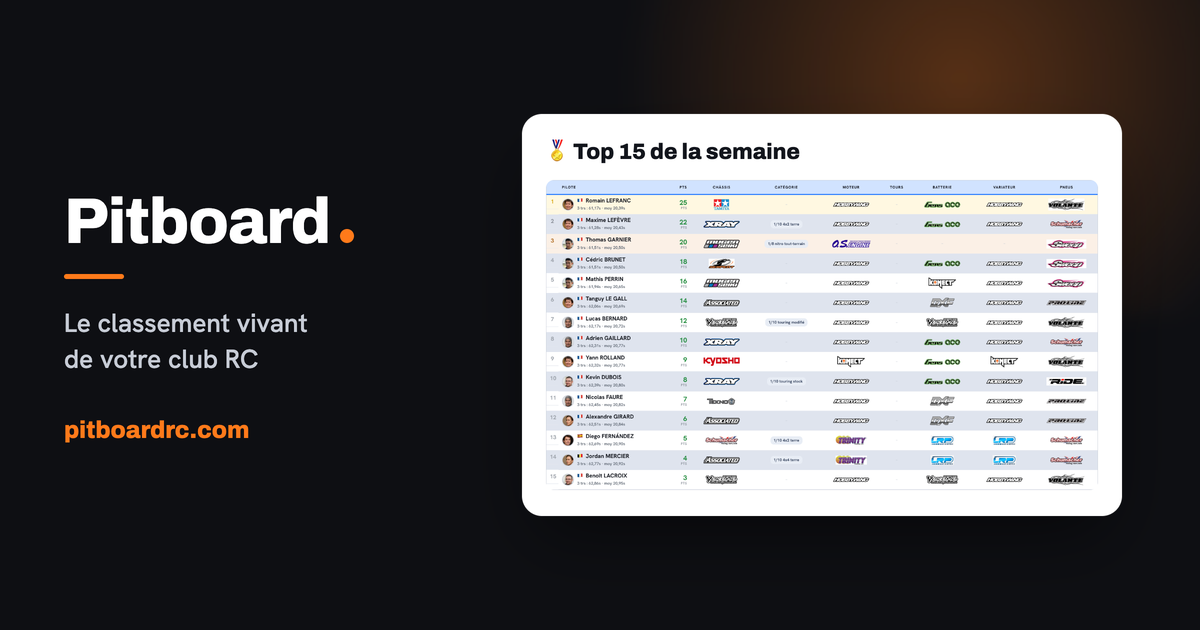
His solution was to plug the club’s website directly into the SpeedHive timing system already in place on the track. Nothing new there — most tracks equipped with a loop and transponders already use it for their races. What changes is that this data, until now only good for establishing a result on race day, starts living all week long. A driver sets down their transponder for free practice, their laps come in automatically, and it feeds the standings, the season championship and the track records. Nobody needs to re-enter anything once they get home in the evening.
It runs on its own, in short. Before, this job almost always fell on the same person on the committee, the one who copied times into a spreadsheet whenever they had time. And they didn’t always have it. The site targets associations, not startups: free to start, nothing to buy on top of the timing system already there, no need for an IT person on the team.
A leaderboard that never sleeps
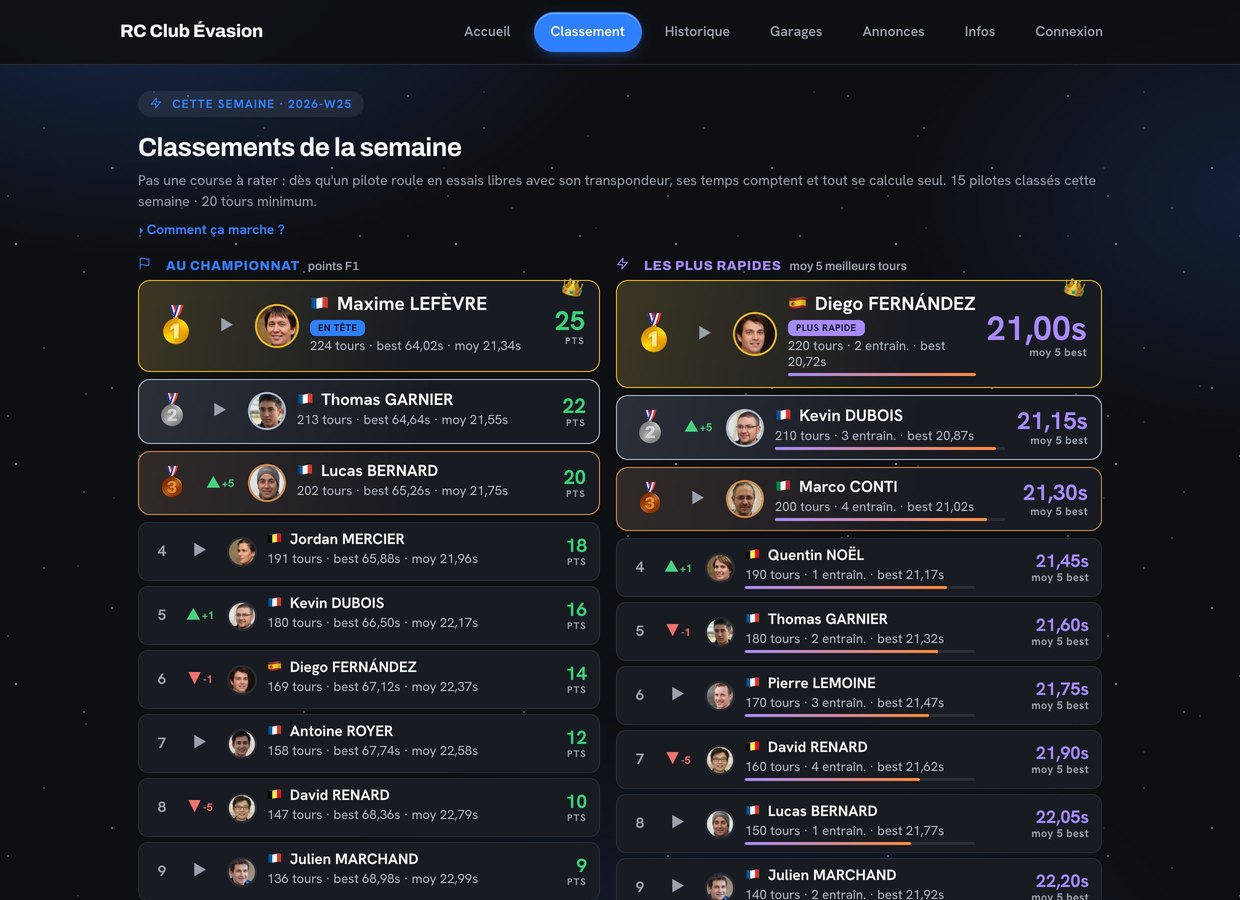
This is the most visible part. Every week, Pitboard puts out a points-based ranking inspired by the F1 scale, built from each driver’s best laps, and runs a season-long championship in parallel. The track record sits at the top of the page, with the driver’s name and the date. Categories (1/10, 1/8, vintage…) stay separate even when everyone shares the same timing system — no mixing a 17.5T stock with a mod in the same table. The site also highlights the week’s most active drivers, not just the fastest.
There’s also a history of past weeks, and a race-day roll of honor kept separate from the free-practice standings. On one side, race-day performance; on the other, consistency over time. And for evenings when nobody feels like organizing anything serious, there’s a “mini races” format: five timed minutes among friends, with the standings displayed live on screen.
That standings board can indeed run live on a screen in the clubhouse, airport-departure-board style. The site also installs on a phone like an app, without going through a store. A small detail that matters for clubs with young members: minors’ names are automatically hidden.
Everyone’s garage
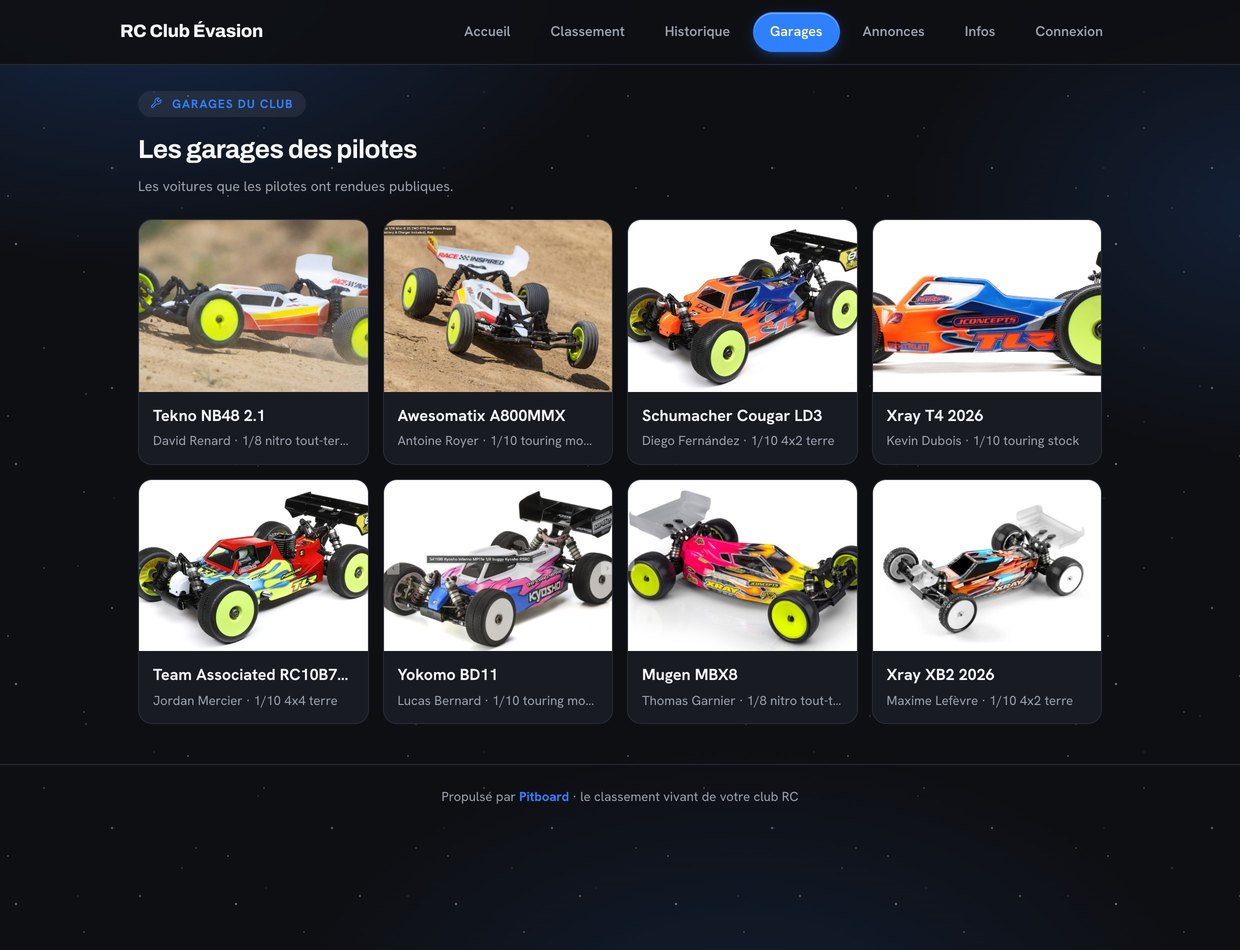
Each driver can also showcase their car: chassis, motor, ESC, tires, and photos if they feel like it. On his own profile, Tony Masclet has posted several quite different cars: a Xray XB2 and an XB4 for carpet racing, a Tamiya Avante, a Schumacher Cougar Classic, and a vintage Kyosho Turbo Optima 87 in TT 1/10 Vintage 4WD, 13.5T motor, Le Mans Gold ESC. You get a driver’s whole history in two clicks, without having to guess from their race results alone.
A garage might sound like a minor feature. But it gets people moving between clubs: a well-presented car, with good photos, spreads on its own. Profiles can also be sorted by brand or chassis, turning the page into a sort of collective catalogue. Handy for anyone torn between two cars before buying who wants to see how others have built theirs.
The setup sheets, the real centerpiece
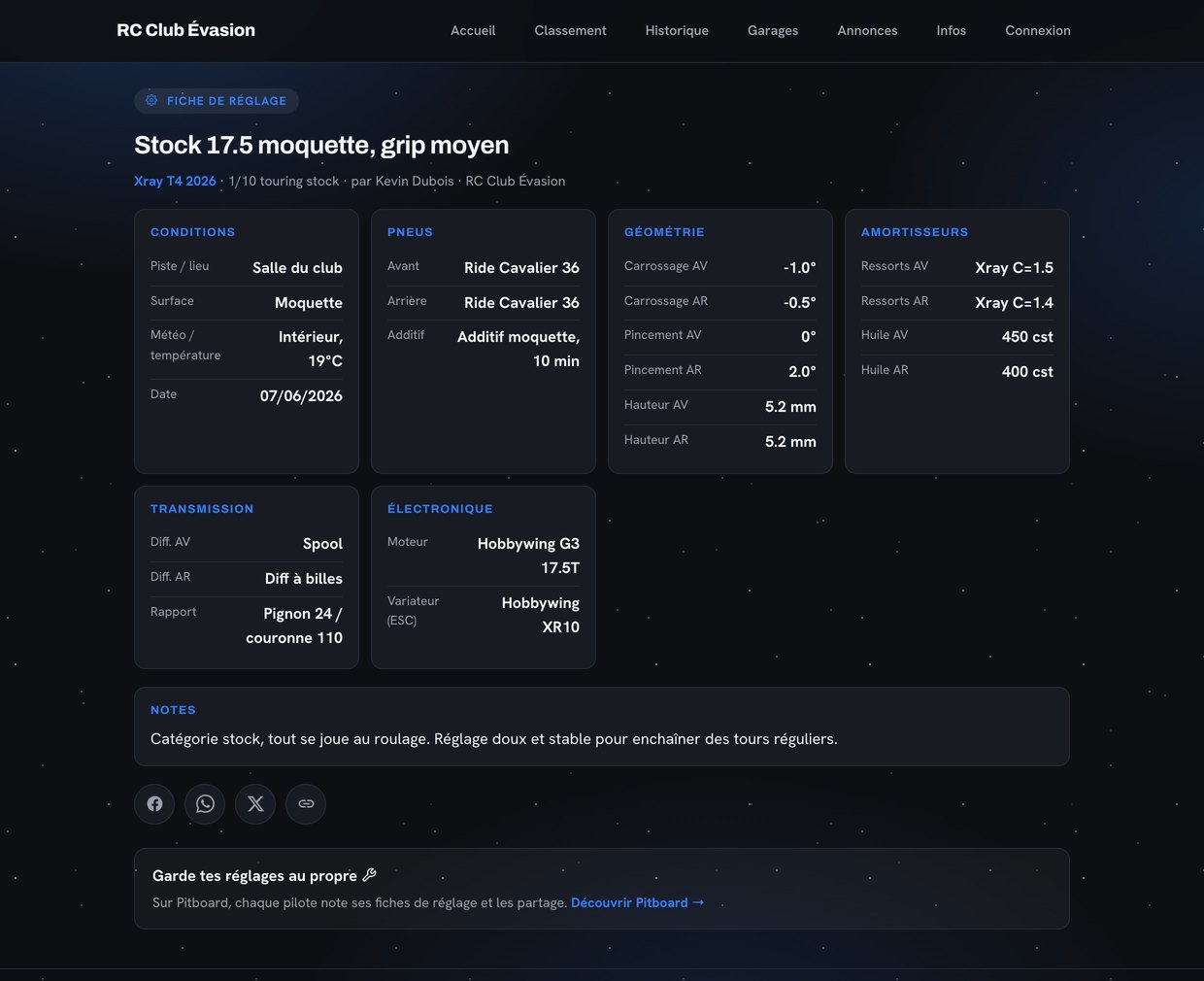
This is where the site put in the most work. Camber, toe, ride height, springs and shock oil, differential, pinion and spur gear: everything is adjusted directly on diagrams you manipulate with a mouse or your finger, not on a bare table to fill in. You can compare two setup sheets side by side, value by value, instead of juggling between two tabs. And the sheet then exports as a clean PDF, ready to hand to a clubmate without retyping the numbers.
Tony Masclet published his own for the Euro Oldschool 2026 in Gottinghem, on astroturf at 22°C: -1.5° camber front and rear, ride height 15mm front and 13mm rear, hard Kyosho springs, final gear ratio 4.05. That won’t interest many people outside the vintage circle, but for anyone looking for a starting point on this exact chassis, it’s exactly what’s needed — and along the way, it leads the reader to the original club without them even looking for it.
For beginners who don’t yet know what a point of toe changes, the site also has a page explaining setups and an RC glossary. A setup sheet is useless if you don’t understand what it’s telling you.
The rest: classifieds, forum, gear calculator
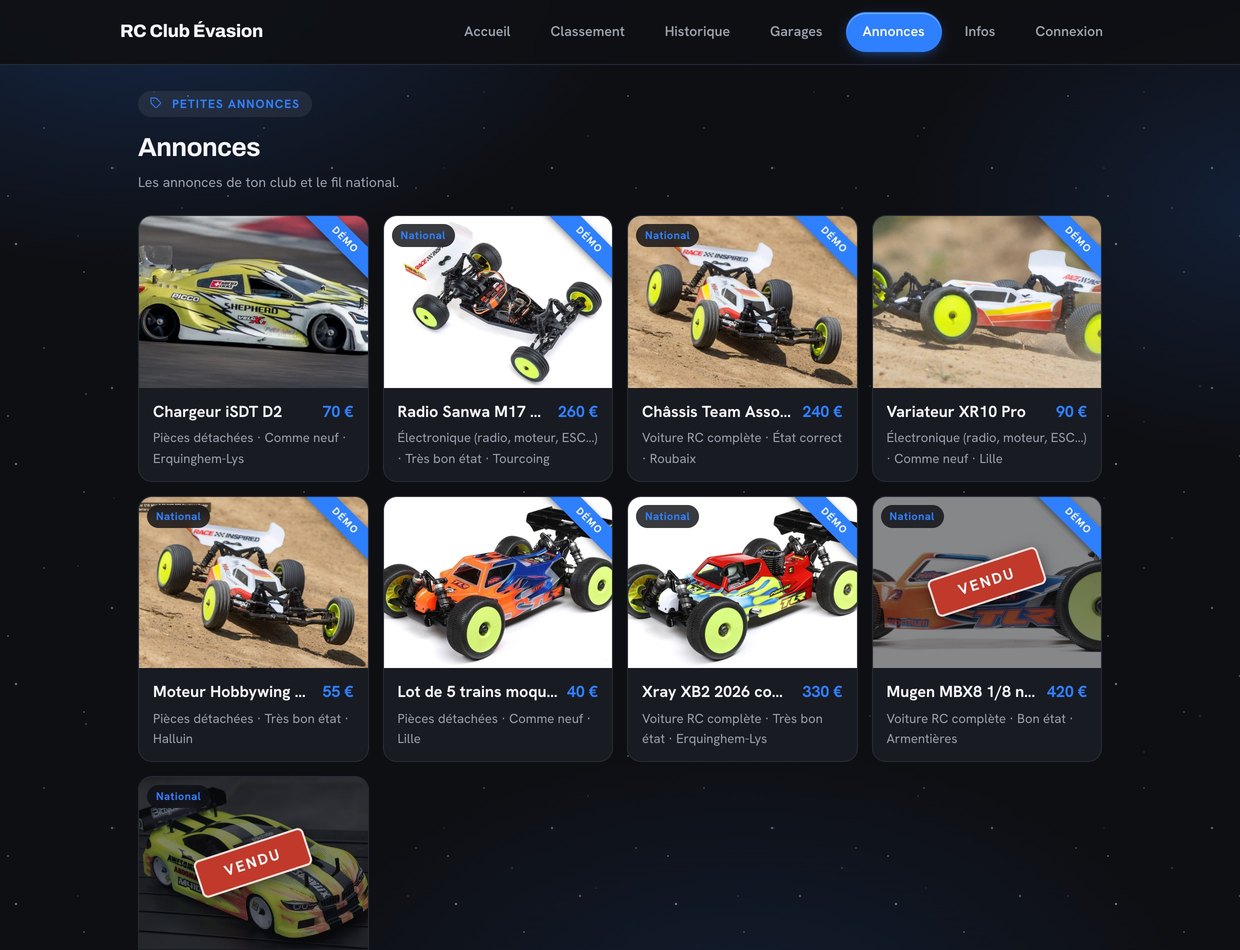
The rest is more toolbox than showcase. Classifieds between members, plus a national feed that goes beyond a single club — handy for offloading a motor nobody local wants, or hunting down a part you can’t find nearby. A forum for discussion. An RC news page to follow the scene without leaving the club’s site.
The gear ratio calculator is freely accessible, no account needed, electric or nitro. For electric, you enter pinion, spur and wheel diameter, and get lap rollout, final ratio, theoretical top speed and wheel RPM. For nitro, the calculation starts from engine RPM rather than KV. Brand presets (Xray, Traxxas…) save you from re-entering values you never remember by heart, and a reverse mode lets you start from a target speed to land directly on the ratio to fit.
Already several clubs on board
RC Park is no longer the only one using the tool. In total, the site claims more than 1.4 million cumulative timed laps, for around 2,500 cars tracked.
Free to start, nothing to install on the club’s side. At launch, Tony Masclet was offering the full package free for six months to the first five clubs to sign up, in exchange for honest feedback and a “founding club” badge to keep afterwards. Those five spots are already taken as these lines are written, but that doesn’t stop anyone from asking about the other plans anyway.
A hesitant club can contact him directly, no need to stand on ceremony. He’s the one who answers, from the club that served as the testbed for the whole tool.
And fundamentally, none of this is reserved for big organizations. It’s actually the opposite: it’s the small volunteer-run club, kept going by two or three already busy volunteers on race weekends, that has the least time to spare for a standings spreadsheet. That the tool comes from a club president who hit the same wall, rather than from a software publisher, is probably not a coincidence.
More information at pitboardrc.com.
Source: Tony Masclet / Pitboard RC (pitboardrc.com)
Read also

RC Team modélisme video: inside the TETC, the all-Tamiya European cup

Tony RC tests the 32one M24 Bee 1:24 mini buggy
